
aiDAPTIV TM

更快的 AI 推理性能与更大规模的 LLM 训练,全程在本地部署(On-Prem)私有环境中完成

How Pascari aiDAPTIV™ Works 

How Pascari 
aiDAPTIV™ Works 

Keep active AI state close to compute 

A system’s fastest memory should hold the data the model needs now, not every piece of AI state the application might need later. This typically includes model components, active KV cache, active MoE experts, activations, and other data required for immediate computation.  

Fast memory is limited. When model weights, context, and active application state compete for that capacity, the system must remove or recompute data, or move it elsewhere.  

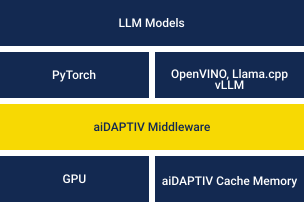
aiDAPTIV= Middleware + Flash Memory

aiDAPTIV Middleware

Orchestrates AI data across GPU, DRAM, and flash memory.

aiDAPTIV Middleware

Orchestrates AI data across GPU, DRAM, and flash memory.
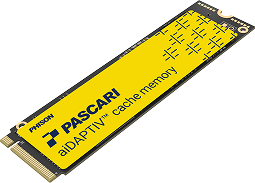
aiDAPTIV Cache Memory

Specialized high-speed, high-endurance SSD optimized for AI workloads.
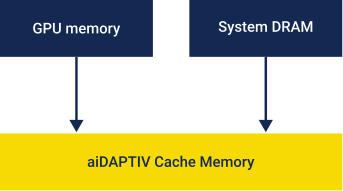
Discrete-GPU system
Unified-memory system

aiDAPTIV works with discrete and unified-memory systems 

Modern AI systems do not all have separate GPU VRAM and system DRAM. 

On a discrete-GPU system, GPU memory and system memory are separate physical tiers. GPU memory is the fast tier and system memory can provide intermediate capacity for staging or near-term data.  

On a unified-memory system, the CPU and accelerator share a common physical memory pool, which serves as the fast tier. Across Intel, AMD, and NVIDIA ecosystems, client and server platforms can use different versions of these architectures. 

The physical layout changes, but the constraint remains the same: model weights, active context, and application state compete for the fastest memory near compute. 

aiDAPTIV Cache Memory serves as a larger retained-capacity tier, where supported, in client, workstation, edge, and server configurations across both architectures. It gives supported AI runtimes more places to retain eligible AI state. Active data stays in the fastest available memory and less-active state can remain available in larger, slower tiers rather than being discarded outright and rebuilt later.    

In supported training integrations, aiDAPTIV can stage model and training state through GPU memory, system memory, and cache memory rather than requiring the complete working set to remain in GPU memory at once. 

Exact handling varies by model, runtime, training method, hardware configuration, sequence length, and batch size. Depending on the workload, data may be retained, moved through the memory system, or recomputed to balance capacity and execution time. 

Different AI data needs different handling 

AI state is not all equally urgent. 

A reusable KV cache prefix may be valuable because a compatible follow-up request can avoid repeating prefill work. An MoE expert may be inactive for the current token but needed again a few tokens later. Fine-tuning state may need to move through the system as the training job progresses. 

aiDAPTIV treats these workloads as AI data with different timing and reuse characteristics, rather than as undifferentiated memory pages. 

When the fast tier fills, the system has three basic choices: 

1

Discard data 

2

Recompute it later

3

Retain it in a larger tier

aiDAPTIV makes the third option practical for supported workloads. It keeps immediate work near compute, retains eligible less-active state in larger tiers, and brings that state forward when the workload needs it again. 

Exact placement varies by model, runtime, and task. The operating principle stays simple: reserve fast memory for immediate work and use lower tiers to extend capacity and retain useful state. 

Capacity is the point — and the tradeoff

Moving data from a lower tier takes time. aiDAPTIV does not erase latency, and it does not make flash equivalent to GPU memory. 

Its value is making a larger or more persistent AI task practical, avoiding unnecessary recomputation, and keeping scarce, fast memory focused on immediate work. 

The question is not whether cache memory is as fast as GPU memory. The right question is whether the memory architecture makes the intended AI task practical on the system you intend to deploy. 

Why this is not swap 

Swap treats memory as undifferentiated pages. 

AI state is not undifferentiated. A reusable token prefix, an inactive MoE expert, and a training activation have different value and timing requirements. 

aiDAPTIV manages those differences rather than merely pushing bytes to storage.

Runtime and platform scope 

Capabilities vary by runtime and version, operating system, GPU or unified-memory platform, model architecture,
system-memory configuration, cache memory configuration, and the AI task itself. 

KV cache extension & reuse
Dynamic MoE
Elastic fine-tuning

SEAMLESS INTEGRATION

  • Optimized middleware to extends GPU memory capacity
  • 2x 2TB aiDAPTIVCache to support 70B model
  • 低延迟

HIGH ENDURANCE

  • 业界领先,高达100次的五年内每日写入次数(DWPD)
  • 采用业界先进NAND 纠错算法的SLC NAND

aiDAPTIV+ BENEFITS

  • 即插即用,无缝集成
  • 无需修改现有 AI 应用
  • Reuse existing HW or add nodes

aiDAPTIV+ MIDDLEWARE

  • 模型自动分割与 GPU 资源调度
  • Hold pending slices on aiDAPTIVCache
  • Swap pending slices w/ finished slices on GPU

FOR SYSTEM INTEGRATORS

  • Access to ai100E SSD
  • Middleware library license

  • Full Phison support to bring up