Faster Inference and Larger LLM Training, Done Privately On-Prem
KV Cache Extension & Reuse
Keep more context. Rebuild less of it.
What KV cache is
LLM inference has two main phases:
During prefill, the model processes the complete input, including instructions, documents, retrieved material, conversation history, tools, and other prompt content.
During decode, the model generates output one token at a time.
As the model processes each token, its attention layers create key and value representations for that token. When the next token arrives, the model uses those stored key and value representations instead of recalculating them for all prior tokens. That stored attention state is the KV cache.
KV cache is not the source document, chat transcript, RAG index, or agent plan itself. Those remain application data. KV cache is the model’s internal working state for tokens it has already processed.
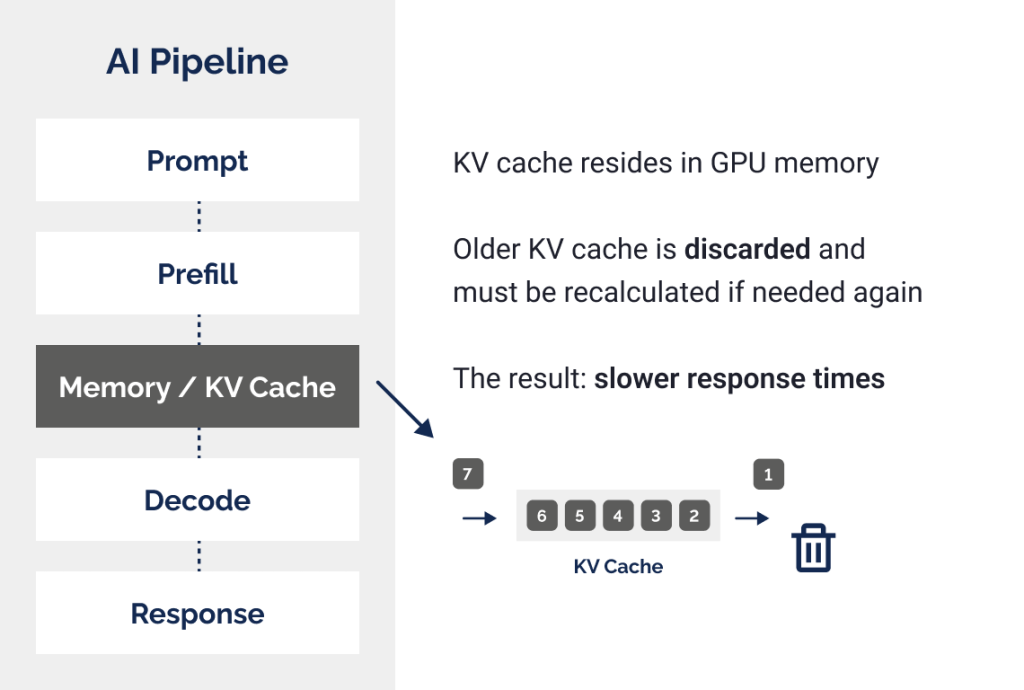
Inference - KV cache explodes memory use
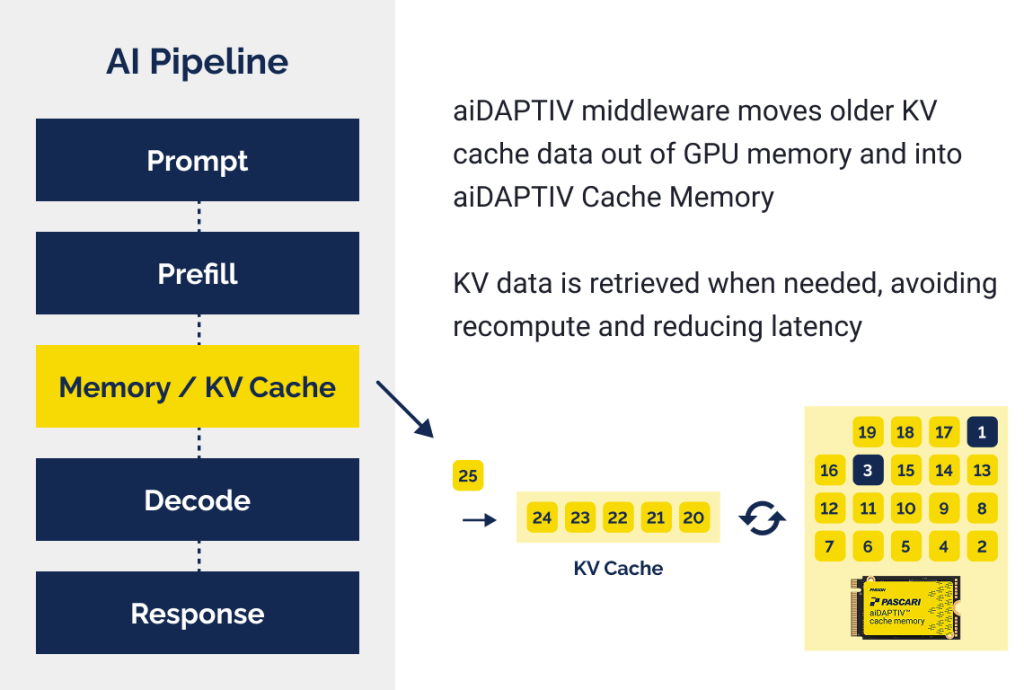
Inference - aiDAPTIV offloads KV cache to flash
Why KV cache becomes a memory problem
Every retained token consumes KV cache memory. The total requirement grows with:
Model architecture and number of attention layers
Context length
KV cache precision
Generated output length
Number of active sequences or users
Long documents, larger RAG inputs, tool-heavy agents, extensive code context, and extended project sessions can all create more active KV cache demand than available GPU or unified memory can hold.
Challenge
KV cache extension
What it means
A live workload needs more retained KV cache capacity than fast memory can hold.
Challenge
KV cache reuse
What it means
Related tasks repeatedly prefill the same unchanged input.
Challenge
What it means
KV cache extension
A live workload needs more retained KV cache capacity than fast memory can hold.
KV cache reuse
Related tasks repeatedly prefill the same unchanged input.
Pascari aiDAPTIV™ helps supported workloads retain eligible less-active KV cache state across GPU memory, system memory, and cache memory instead of discarding it immediately when fast-memory capacity is constrained.
GPU memory or unified memory remains the primary working-memory. Lower tiers add retained capacity; they do not make flash perform like GPU memory.
Reuse is exact, not semantic
KV cache reuse depends on token identity.
The shared token sequence must match from the beginning of the prompt through the portion being reused. The first mismatch ends reuse for the remainder of that sequence.
Two prompts can be semantically similar but still fail to reuse cache if their token order, punctuation, formatting, tool definitions, document order, or system prompts differ.
That makes prompt structure important. A stable system prompt, fixed tool definitions, a long source document, fixed context blocks, or a repeatable agent configuration can create a useful reusable prefix.
Reuse reduces prefill work. It does not eliminate it.
When a reusable prefix matches, the system can avoid recomputing that processed portion of context.
The new question, changed suffix, tool response, or next agent step still needs to be processed.
Reuse depends on runtime support and compatible input. Applications must preserve shared material in a stable order, with changing input appended later.
Exact-prefix KV reuse
Reuse stops at the first change
To maximize reuse, keep shared instructions, tools, and documents at the beginning and place changing input (questions, tasks, or steps) at the end.
RAG pre-caching
Traditional RAG can limit reuse when every query assembles retrieved chunks in a different order.
A cache-aware RAG workflow organizes related material into fixed context blocks. It can retain the KV cache state for each block, retrieve relevant material for a new question, select a compatible block as the stable prefix, and append the live question afterward.
This does not eliminate retrieval or reasoning. It reduces repeat work when related questions depend on the same underlying material.
Prepare stable context blocks ahead of time, then add the live question later
1
Documents / knowledge base
2
Stable context blocks
3
Precompute KV cache
4
Store in aiDAPTIV Cache Memory
5
Live question
6
Less repeat prefill work
Still retrieves and reasons; reduces repeat work.
Agent workflows are not one prompt
and one answer
An agent often works through a loop:
Plan
Act
Observe
Repeat
Each step can add system instructions, tool schemas, search results, database responses, retrieved documents, intermediate outputs, working artifacts, and outputs from sub-agents.
A task that begins with a modest context window can become a long-running memory problem before you see the final result.
Where extension and reuse help most
KV cache extension and reuse are most useful when meaningful context remains stable across related work:
Long-document workflows
Private or enterprise RAG systems
Coding tools with repeatable project context
Agents that retain the same instructions, tools, and task state across multiple steps
It is less useful when every prompt changes from the first token onward, the shared prefix is short, context is rarely reused, or the runtime does not support the required cache behavior.
Dive deeper on KV cache
Learn how aiDAPTIV can extend eligible KV cache retention and reuse compatible shared input across document, RAG, coding, and agent workflows.



 English
  繁體中文
繁體中文
 简体中文
简体中文
 日本語
日本語